


Roman Origins
The history of cast stone effectively dates back to ancient Rome when pozzolanic cement was utilised. The use of this new cement with natural aggregates, and often natural stone, including lightweight pumice, and bricks from demolished buildings, allowed the Romans to form a structural material, also known as opus caementicium, for use where quarried stone would previously have been used such as in the vaulted arches and gateways of the Colosseum and for the large span dome of the Pantheon.

Development of Artificial Stone
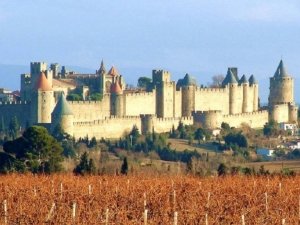
Cast stone was widely used in European countries and the earliest known extensive use of cast stone being used in a position where it was intended to be seen dates from around 1138 in the UNESCO World heritage listed fortified medieval walled city of Carcassonne in France. Lintels resembling natural stone were cast from natural aggregates and lime-pozzolan cement and used in the repair of the walls of the fortified city of Carcassonne.

Simulated Stone in Britain
The earliest reference to artificial stone uncovered in England relates to Sutton Place in Surrey, where Henry VIII’s (1491-1547) brewer is recorded as having used ‘artificial stone or brick’ extensively. [1]
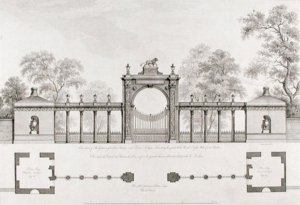
As early as 1770 in UK, Daniel Pincot identified the refusal of some to accept that an artificial stone can be superior to its natural equivalent; ‘there are some persons so obstinately averse to the introduction of whatever they imagine has but the air of novelty, that they will be both blind and deaf to the plainest demonstration.’ [2] He found this incredibly frustrating as he believed that ‘artificial stone …. though the outward appearance is nearly the same, the internal properties are totally different, and far superior to all the common sorts of rock stone.’ [3]
Coade Stone
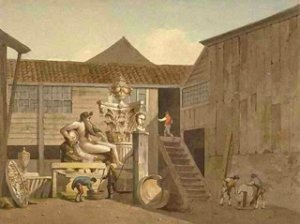
Although by no means the first manufacturer, the first architecturally significant use of simulated stone in UK was Coade Stone. Mrs Coade bought Daniel Pincot’s ailing artificial stone business in Lambeth. The company did well under the new ownership and Coade Stone was used extensively for classical detailing from around 1770 onwards by architects of the time, including Robert Adam, John Nash and Sir John Soane.
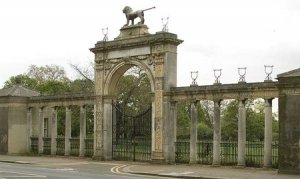

One notable example of the use of Coade Stone was by Robert Adam on the Syon Park Gateway and Porters’ Lodge.
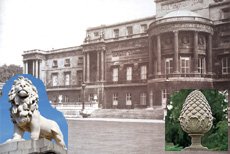
Coade Stone was also used on the rear elevations of Buckingham Palace and numerous ornamental cast stone items, including the Westminster Bridge lion and Ham House pineapples. Coade Stone was not a cement based product, as cast stone is today, but a fired clay composition. Coade Stone declined in popularity towards the middle of the 19th century to be replaced by a cement based cast stone which has continued up to the present time with increasing popularity.
Patent for Portland Cement
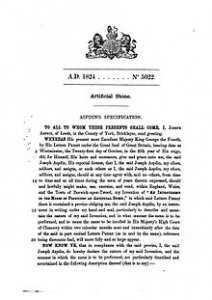
The rediscovery of concrete in the 19th century and the invention of Portland cement – which resembled Portland limestone in colour – led to a large number of patented ‘artificial’ stones. Joseph Aspdin, a Leeds bricklayer took out a patent for his Portland cement in 1824 though he claimed he had been making it since 1811.[4] By 1863, Portland cement was deemed to be ‘quite common cast in ornaments’.[5]
First Cement Based Cast Stone
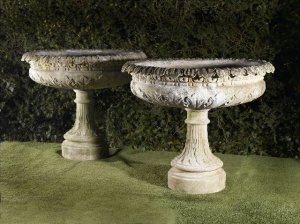
The first recorded commercial production of a cement based cast stone material in the format we know today, was in the late 1820s when Felix Austin went into business making artificial stone in New Road (now Euston Road), London, England. His material was not the same as the ceramic body used by Mrs. Coade, (although he is known to have copied old Coade designs), but made from Portland cement, broken natural stone, pounded marble and coarse sand.[6]
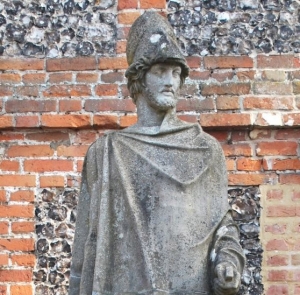
Around 1840 Austin entered into partnership with John Seeley. Seeley had trained at the Royal Academy Schools and also made an artificial stone, which he called ‘ artificial limestone ‘, before entering into partnership with Austin. In 1841 Austin and Seeley published their first catalogue, Collection of Ornaments at Austin & Seeley’s Artificial Stone Works for Gardens, Parks and Pleasure Grounds. The firm continued in production until about 1872.
Although their cast stone products were rarely stamped with the makers mark, items by Austin and Seeley can often be identified by their quality, which was recognised by Queen Victoria, who can be included among their patrons. Their urns and statues remain in great demand and currently achieve prices of many thousands of pounds at auction.
20th Century Cast Stone
As the twentieth century dawned and cement based manufacture became more widespread, William Diack in 1904, in The Stone Trades Journal, commended cast stone as a substitute for natural stone in all areas.[7]
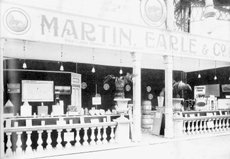
Cement manufacturer Martin Earle & Co’s stand at the Building Trades Exhibition at Olympia 1910 featured some early examples of cast stone products, including balustrading, columns, pedestals and urns, which were being exported all over the world.
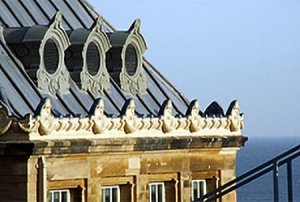
The revival of neoclassical forms in the 20th century aided the use of reconstructed stone to emulate natural Portland stone facades.
The Architects’ Journal, in 1932, when comparing Bath natural stone to its artificial equivalent, identified that ‘the reconstructed material is … much more durable, and has no natural bed, so there can be no flaking of the surface. It is unaffected by sea air, and the face is not destroyed by sulphurous atmosphere.’[8]
Cast stone had become accepted as a viable alternative to natural stone.

Cast stone today
By the late 1980s, perceptions were changing once again: ‘ cast stone has come a long way since then and some feel that the best look so like the real thing that they could threaten the future of the stone industry.’[9] ‘ Cast stone may, when properly designed, manufactured and installed, be as durable as many natural stones.’[10] For this reason, by 1989, The Journal of Preservation Technology was describing cast stone material as being ‘fully accepted’.[11]
Cast Stone replacement for Natural Stone
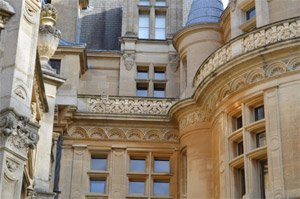
Dry-cast cast stone from UKCSA Full Member Haddonstone was the material chosen by the National Trust for the restoration of the highly eroded carved natural stonework on the ornate parapets at their Grade I listed property – Waddesdon Manor, Aylesbury. The cast stone replacements were colour matched to the natural stone colour and are now indistinguishable from the original stone.

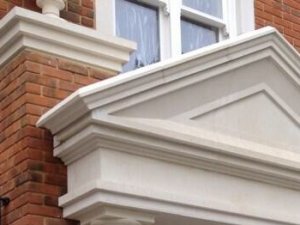
Cast stone was increasingly used for structural applications and larger panels with complex reinforcements. And post modernist architects use classical cast stone detailing to relate to an existing context such as brickwork with string courses, pediments, gables and cornices. The material is widely used by house builders to add value to their schemes.

In the 1990s much research relating to artificial stone was undertaken by the University of Dundee, the potential importance of this being recognised by Building Design in 1990: ‘The Dundee programme may well lead to concrete as architectural cast stone being reinstated as a high quality 21st century building material.’[12] The Dundee programme culminated in a joint research project into cast stone by the University of Dundee and the UK Cast Stone Association (UKCSA), making a number of interesting conclusions relating to artificial stone when compared to natural stone, in effect stating that both materials are generally comparable: ‘ All Cast Stone products, and particularly when waterproofed, were found to be highly resistant to carbonation. Efflorescence did not occur in any of the test samples and weathering in Cast Stone was similar to that in control natural stone. The data also suggests that dry-cast, Cast Stone is no more vulnerable to frost attack than natural stone.’[13]

‘Unfortunately for contemporary advocates of artificial stone, whilst poor artificial stone is rightly vilified, good artificial stone so quickly takes on the appearance of natural stone that it is often mistaken for, and assumed to be, natural stone and so is not given the acclaim it deserves.’[14]

Standards for Cast Stone
The first British Standard for Cast Stone was BS 1217, which having been approved by the Cement, Lime & Gypsum Industry Committee was published on 6th April 1945, and in 2020 BS 1217 celebrated its 75th anniversary. Subsequent revisions to BS 1217 were produced in conjunction with the UK Cast Stone Association in 1975, 1986 and 1997, with the latest version being produced in 2008. BS 1217 is regularly reviewed by the Association and the BSI in order to reflect developments in the industry, and was last confirmed as “Current” by the BSI in July 2018.

Quality Cast Stone
‘Through technological advances and rigorous testing regimes, the quality of cast stone from a United Kingdom Cast Stone Association member is undoubtedly higher and more consistent than has been created at any time in the history of artificial stone. One can only wonder how historians will review the works of present day manufacturers in the centuries to come, for it would appear that it is only with hindsight that we are prepared to properly judge this material.’[15]


References:
[1] John Cladius Loudon, ‘Encyclopaedia of Cottage, Farm and Villa Architecture and Furniture’, London 1846, P142
[2] Daniel Pincot, ‘Artificial Stone’, London 1770, p11
[3] Daniel Pincot, ‘Artificial Stone’, London 1770, p35
[4] ‘The History of Blue Circle’, 1988
[5] Robert Kerr, ‘On Artificial Stone’ RIBA Transactions 1862-63, London 1863, P145
[6] ‘The Builder’, 1868
[7] William Diack, ‘The Art of Masonry in Britain’, The Stone Trades Journal, 1904
[8] F.R.S Yorke, ‘ Concrete and Artificial Stone ’, Architects Journal, 1 June 1932 p729
[9] Charles Wagner and Ian McCaig, ‘ Cast Stone ’, Traditional Homes, October 1987, p10
[10] Charles Wagner and Ian McCaig, ‘ Cast Stone ’, Traditional Homes, October 1987, p12
[11] ‘ The Journal of Preservation Technology ‘, Vol XX1, Nos. 3 / 4 1989
[12] Richard Carr, ‘ Set in their Ways ’, Building Design, 26 October 1990, p33
[13] ‘ Research Study into the Development of a Standard Test method and Performance Specification for Cast Stone ‘, University of Dundee
[14] Simon Scott, ‘ Artificial Stone. A successful substitute for natural stone? ‘, 2009, p100
[15] Simon Scott, ‘ Artificial Stone. A successful substitute for natural stone? ‘, 2009, p103
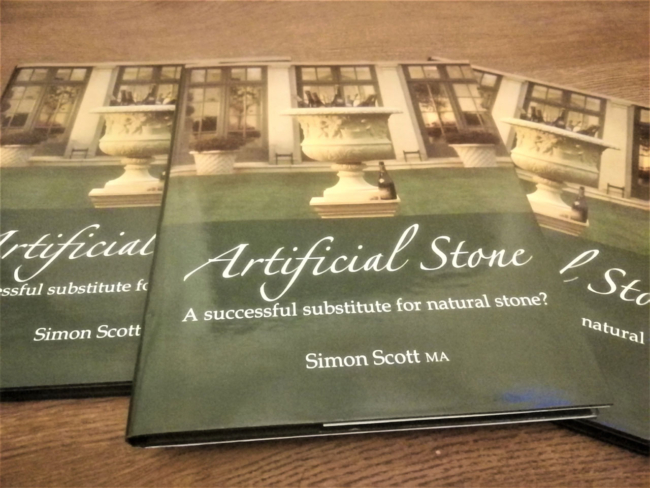
‘ Artificial Stone. A successful substitute for natural stone? ‘
This acclaimed volume provides a history of the most important manufacturers of artificial stone from before Coade Stone in the eighteenth century to the present day. Topics covered range from alternative production techniques to historical and contemporary perceptions of the material.
Copies of ‘Artificial Stone. A successful substitute for natural stone?’ are available to purchase direct from the author Simon Scott, at simon@simonscott.org.uk
Follow UKCSA


